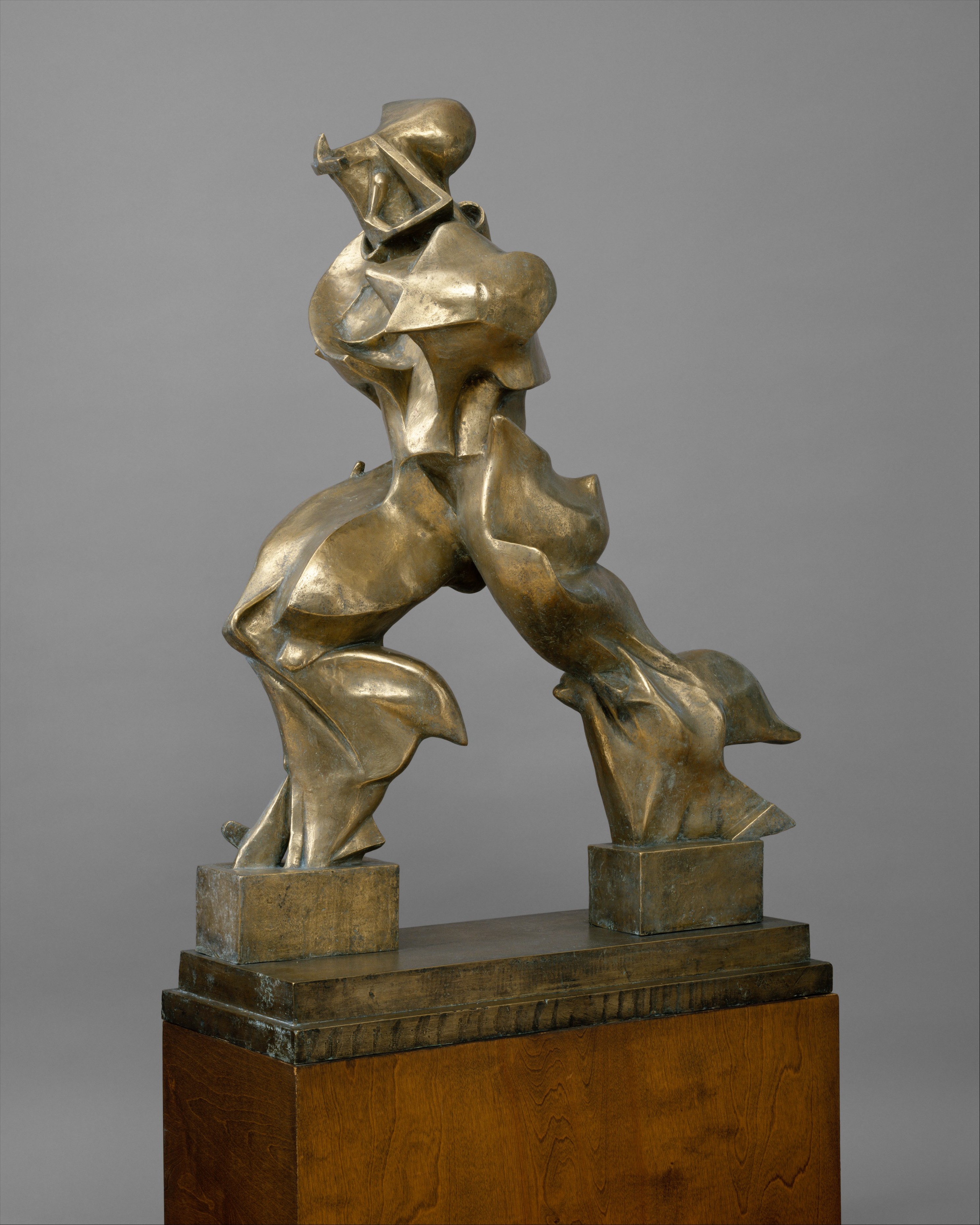
Unique Forms of Continuity in Space, modeled by Umberto Boccioni in 1913 and cast in bronze in 1950, is among the most recognized sculptural statements of Italian Futurism, its striding, wind-shaped figure conceived to render motion and force as continuous form rather than a fixed pose. The 1950 casting date, well after Boccioni's death in 1916, is itself an important part of the object's documented history, since posthumous casts of this design exist in multiple institutional collections and their sequencing has been the subject of careful scholarly study. Weighing some ninety kilograms, the bronze entered the collection through the bequest of Lydia Winston Malbin in 1989. Scion treats the distinction between an artist's design date and a cast's production date as a routine but essential element of due diligence for sculpture.