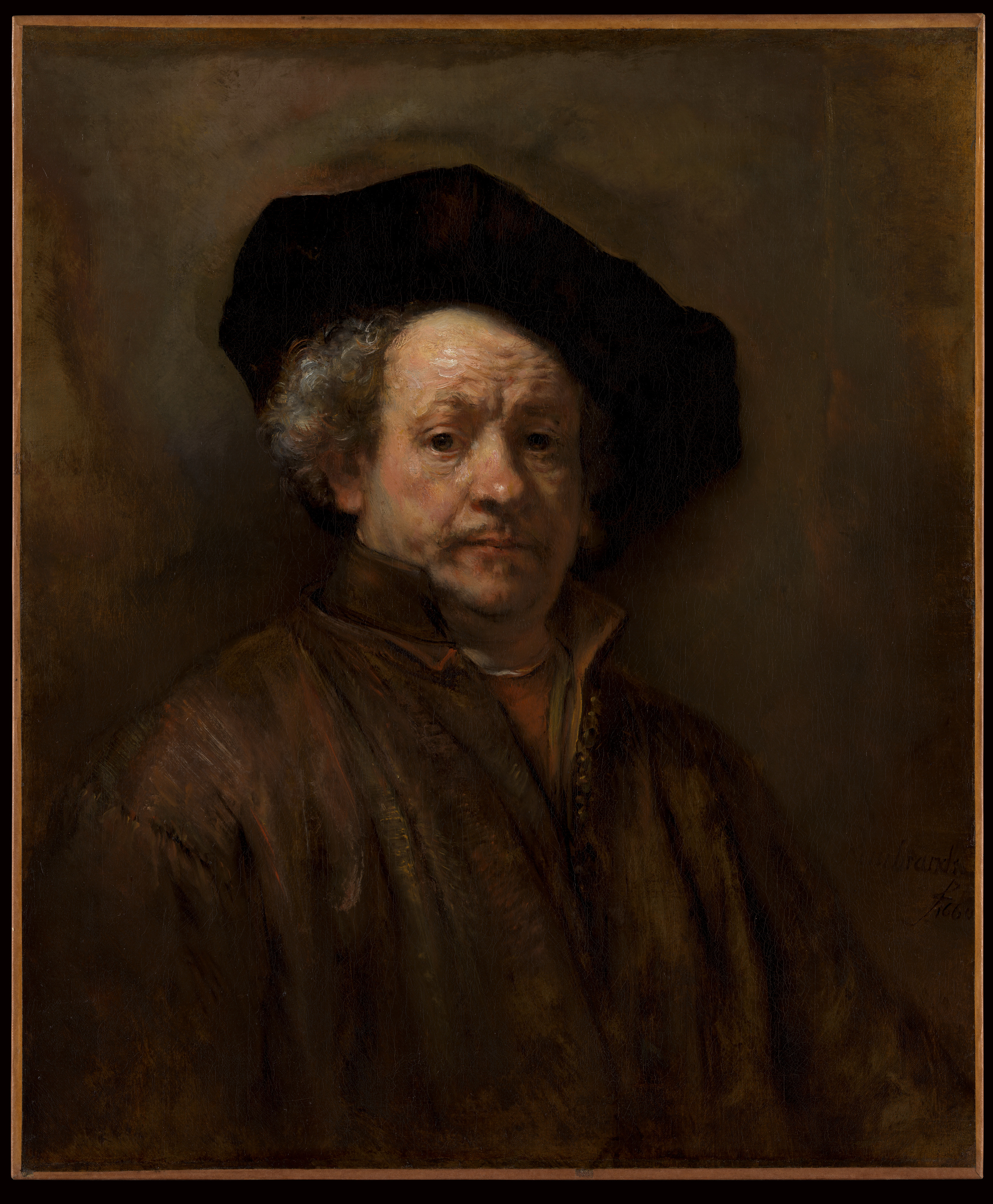
Painted in 1660, this self-portrait belongs to the sequence of searching, unflattering likenesses Rembrandt van Rijn produced through his later years, when the fluent brushwork and buttery impasto of his maturity gave way to a rougher, more agitated handling of paint. The sitter's face is built from thick, visible strokes that catch light unevenly across the surface, a technique that trades polish for psychological candor. Rembrandt's late self-portraits are widely read as a private reckoning with age and reversal of fortune, and this canvas, entering the collection through the Benjamin Altman bequest of 1913, has remained in the public record ever since. For us at Scion Art Advisory, works of this kind — securely attributed, continuously documented from a named institutional source — represent the standard against which more ambiguous attributions and gapped ownership histories are measured.
Cross-checking this against the Met's own provenance record before I hand it to you, since pubhist has one questionable link ("sold to Sulley?" with a question mark).
The Met's page didn't render the detailed provenance tab in this fetch (it's behind a tab-loaded panel), but pubhist.com — which draws on the RKD (Netherlands Institute for Art History) database — gives a workable chain. Here's the provenance prior to the Met:
Provenance (pre-1913):
- Duc de Valentinois, Paris
- Admiral William Waldegrave, 1st Baron Radstock, London and Mayfield — until his death in 1825
- His estate sale, Christie's, London, 13 May 1826, no. 31, purchased by the Baring family
- Alexander Baring, 1st Baron Ashburton, London, 1826 – died 1848
- The Barons Ashburton (family collection), London, 1848–1889
- Francis Denzil Edward Baring, 5th Baron Ashburton, London, 1889–1907, sold onward (pubhist marks this transaction with a question mark — "sold to Sulley?" — so treat that link as unconfirmed)
- With Sulley and Co., London
- With Charles Sedelmeyer, Paris, until 1909, sold to Altman
- Benjamin Altman, New York, 1909 until his death in 1913
- Bequeathed to the Metropolitan Museum of Art, 1913 (accession 14.40.618)
A few notes for your purposes as a dealer/advisor:
- The 1907–1909 link (Ashburton → Sulley → Sedelmeyer) is the softest point in the chain as sourced here — worth verifying against the Met's own published provenance (their "Provenance" tab) or the RKD record (rkd.nl/images/29850) before you rely on it for anything client-facing.
- This is consistent with the documented Corpus of Rembrandt Paintings scholarship (cited on the same page: Corpus IV no. 20, Corpus VI no. 282), so the attribution itself is uncontested.